.svg "protagx-logo (1024 × 300 px)")

DATA DIVERS DIALOGS · ANALYSIS
We like to tell the story of a peaceful network that fell into the wrong hands. The paperwork tells a duller and more useful one: the military question was in the brief from the first day, and it now lives in your pocket under a different name.
By Christian Schappeit · Data Divers Dialogs · October 2026 · approx. 9 min read
On 26 October 1957, the beeping stopped.
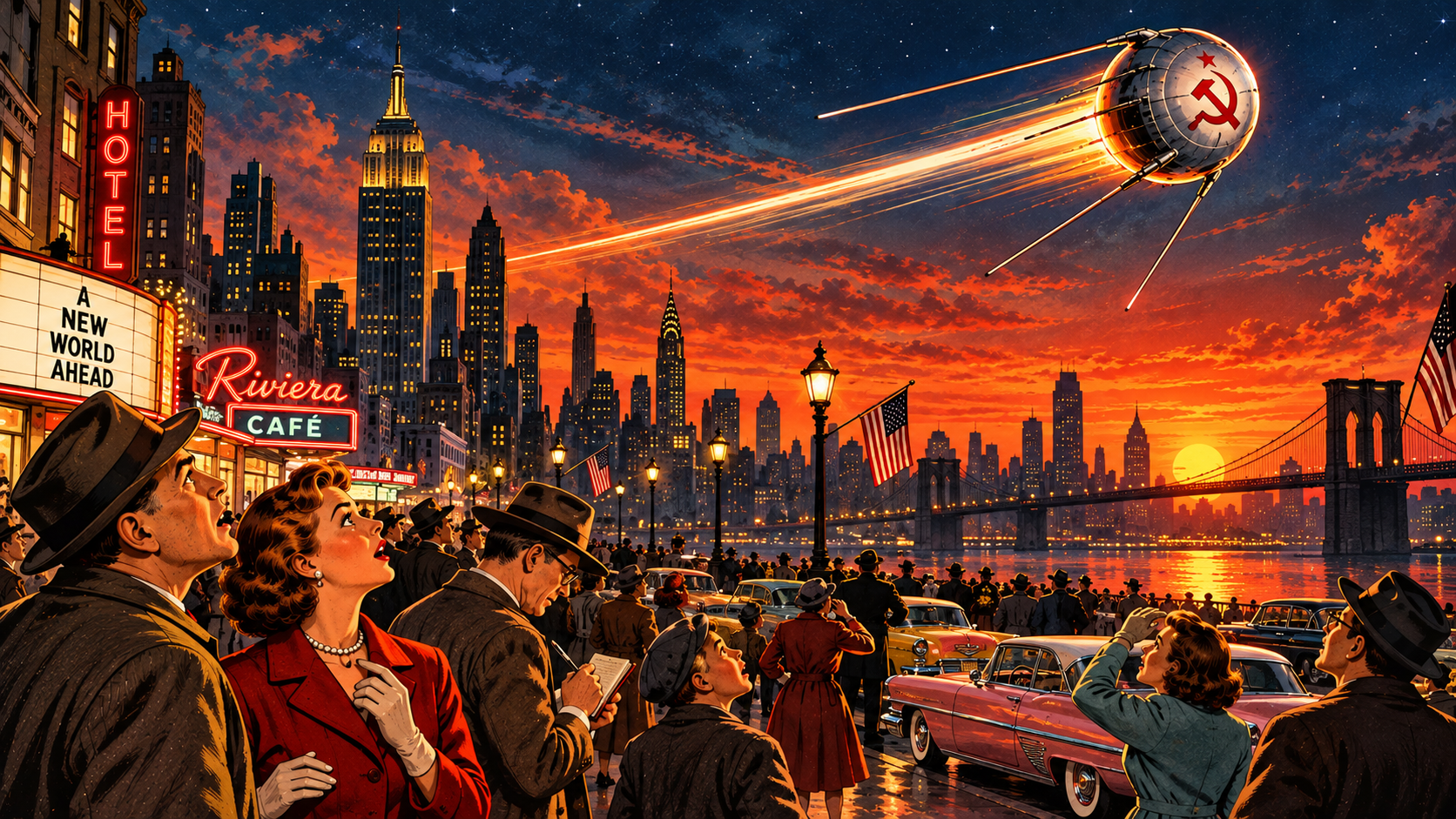
For three weeks a polished metal sphere about the size of a beach ball had circled the Earth, sending the same short pulse on 20.005 and 40.002 megahertz. Anyone with a decent shortwave receiver could listen in. At dusk, people in American cities looked up and saw something cross the sky. Usually it was not the satellite at all, which was barely visible, but the spent core stage of the rocket that had carried it, bright as the brightest stars. Then the batteries ran out, and Sputnik went quiet.
The silence calmed nobody. The rocket was a modified intercontinental ballistic missile, and everyone had understood what that meant. In February 1958, Washington founded the Advanced Research Projects Agency.
There was a second consequence, quieter and stranger. The satellite had passed over dozens of countries, the United States included, and not one government had protested. Deputy Secretary of Defense Donald Quarles told Eisenhower that the Soviets had "done us a good turn, unintentionally". The right to fly over anybody from orbit now existed, and America's own spy satellites were going to need it. The first object to pass over everyone was dual-use from the day it launched.
Eight years later, Bob Taylor had three terminals in his office at the Pentagon. Each one was wired to a different computer at a different research site. Each one wanted its own login and spoke its own dialect of commands. To talk to three groups of scientists, Taylor had to become three different users.
So he walked down the corridor to his boss. Charles Herzfeld, then director of ARPA, the agency born of that silence, later described the meeting in one sentence: "One day Taylor dropped into my office, and he got $1 million in 20 minutes."
That is how the internet started. Not with a vision of a global village. With a man who was tired of switching keyboards.
LOS ANGELES, 29 OCTOBER 1969
The first message was half a word
Three years later, at UCLA, a student programmer named Charley Kline tried to log in to a computer at the Stanford Research Institute in Menlo Park. He meant to type LOGIN. The L arrived. The O arrived. Then the system crashed.
The first message ever sent across the network was "LO". A second attempt worked.
It is a lovely story, and it is usually told as a lovely story: young engineers, a crash, a happy ending. What gets left out is the letterhead. The line between Los Angeles and Menlo Park was paid for by the US Department of Defense, through ARPA, out of an office that had started life in 1962 with a mandate to carry computer research from air defence into "other military command and control systems".
"Nobody weaponised the internet. It came with the uniform already on."
The popular version adds that the network was built to survive a nuclear war. Herzfeld spent years correcting that. In his telling, the ARPANET grew out of a shortage: too few powerful research computers, too many researchers far away from them. Taylor's three keyboards, multiplied across a country.
And yet the bomb is not a myth either. It just sits one building over. In 1964 Paul Baran at RAND, the Air Force's think tank, published a memo on distributed communications whose stated goal was to keep hundreds of stations talking "after an enemy attack". His idea was to chop messages into small blocks and let every node pass them on, with no centre that could be destroyed. Vint Cerf, one of the fathers of the protocol the internet still runs on, once summarised the routing principle in a sentence: "If you receive a packet, get rid of it and send it somewhere else."
So the honest answer to "was the internet military?" is yes. The more interesting answer is: in what way. Not the bomb. The brief. Everyone involved was paid to think about one question. How do you get the right information to the right person fast enough that they act on it?
In the army that question is called command and control.
On your phone it is called a notification.
23:40, A TUESDAY
She lives 2.3 kilometres away and needs you to tap
You are scrolling something harmless. Between a recipe and a colleague's holiday photos, an ad: a woman in a stock-photo kitchen, allegedly 2.3 kilometres from you, has been trying to reach you. Tap. Tap. Tap. The internet has a four-letter acronym for her genre, and you already know which one.
She does not exist, and the ad knows that you know. It does not need you to believe anything. It needs one tap.
Here is what that tap does for you: nothing. Here is what it does for someone else. It settles an auction that ran before the page finished loading. It confirms that this device, at this hour, responds to this kind of picture. And it moves a profile one notch further in a direction you did not choose.
Taylor wanted one screen that could reach every computer. He got it. The quiet inversion of the last fifty years is that every computer can now reach the screen.
ARLINGTON, JULY 2011
The military came back to see how its child had grown up
In 2011, DARPA, as ARPA is now called, invited proposals for a programme with the unglamorous name Social Media in Strategic Communication. Budget: 42 million dollars. The goal, in its own words, was to "detect, classify, measure and track the formation, development and spread of ideas and concepts (memes)", and to recognise "persuasion campaign structures and influence operations". It ran for about four years and produced more than 200 papers.
Read charitably, that is defence: find the other side's propaganda before it works. Read plainly, it is a reminder that the people who paid for the pipes never lost interest in what flows through them.
In 2014, Facebook published a study for which it had adjusted the news feeds of 689,003 users for one week in January 2012, hiding some of their friends' positive or negative posts to see whether moods would spread. They did, a little. The journal later attached an editorial expression of concern.
Facebook is not the army. That is precisely the point. Nobody needed a general. The commercial internet runs the persuasion experiment as part of normal operations, because measuring which stimulus produces which response is the business model.
"The dual use is no longer between soldiers and civilians. It runs between you and your feed."
THINKING ABOUT THE UNTHINKABLE
The phrase is older than the problem
At this point it is tempting to say that we must finally think the unthinkable. It helps to know where that phrase comes from. In 1962 Herman Kahn, the nuclear strategist who had made his name at RAND, the same think tank where Baran drew his network, published a book called Thinking About the Unthinkable.
Which may be the most useful thing to know before deciding how paranoid to be. The people who built this world did not hide the unthinkable. They put it on the cover. The problem is not that the origin is secret. It is that the origin is boring: a budget line, a memo, a man with three keyboards.
So the education we need is not conspiracy literacy. It is plumbing literacy. Knowing that the tap is a bid. That a free app is paid for with something. That "why am I seeing this?" is a real question with a real answer, and that somebody wrote the answer down.
Somewhere between ignoring the obvious and seeing a general behind every banner, there is a person who simply knows how the thing works. That person is harder to steer. Not immune. Harder.
BRUSSELS, 5 DECEMBER 2025
Europe regulates the shop window, not the street
The EU's Digital Services Act is the most serious attempt anyone has made to put rules on that plumbing. Since February 2024 it has applied to every online platform in the Union. It prohibits interfaces that deceive or manipulate users. It bans targeted advertising to children, and ads built on sensitive data such as religion or sexual orientation. Very large platforms must keep public archives of the ads they run. Fines can reach 6 percent of worldwide annual turnover.
The first fine landed on 5 December 2025: 120 million euros against X. The reasons were a blue checkmark that anyone could buy, which the Commission said deceived users and exposed them to impersonation scams; an ad repository that did not do its job; and terms that kept researchers out. On 6 February 2026 the Commission told TikTok, in preliminary findings, that its addictive design broke the law. On 10 July it told Meta the same about Instagram and Facebook, and asked for infinite scroll and autoplay to be switched off by default.
Nineteen days after the X fine, the dual use came back in its oldest costume. On 24 December 2025 Washington denied visas to five Europeans, among them former Commissioner Thierry Breton and the two heads of the German organisation HateAid. Secretary of State Marco Rubio said they had "advanced censorship crackdowns". A rule about blue checkmarks had become foreign policy.
So does the DSA de-escalate? Partly, and in a very specific place. It does not touch the network. It cannot, and it should not try, because the trait that makes the internet dual-use is the same trait that made it work. A packet does not know what it carries. Hot potato. Get rid of it, send it somewhere else.
What the DSA touches is the layer on top, where somebody decided what the notification says, how long the feed runs and who sees which ad. That layer was never in the genome. It was a product decision. Product decisions can be regulated.
TWO DATES FOR THE DIARY
29 October — the network turns 57. Fifty-seven years since "LO". A good evening to open the ad settings on your phone and read what they think you are.
Q4 2026 — the Digital Fairness Act. The Commission's work programme lists a legislative proposal for this quarter, aimed at dark patterns, addictive design and influencer marketing in consumer law. The DSA governs platforms. This one would reach everyone who sells something on a screen.
WHAT'S LEFT
Put the crash back
Is the battle lost? Only if you believe it was ever about the pipe. Nobody knocked out the gene. The gene is indifference, and it is still there, doing what it was paid to do in 1966: connect everything to everything, and never ask why.
The fight is about defaults. About whether the feed ever ends.
Look again at the first message. Two letters, then a crash, then people went to fix it and tried again. The very first thing the network ever did was stop. Twelve years earlier, the satellite that set all of this in motion had done the same: twenty-two days of beeping, then empty batteries, then silence.
Infinite scroll is the engineering of never reaching that crash. When the Commission asked Meta this summer to switch it off by default, it was, without saying so, asking for something very old.
Put the crash back.
Figures and sources. Herzfeld's "$1 million in 20 minutes" is from Gary Anthes' interview with him in Computerworld, 24 September 2007. Taylor's three terminals are reported in his 2017 obituaries and in histories of ARPA's Information Processing Techniques Office, which also give the office's 1962 command-and-control mandate. The first ARPANET message, "LO", was sent on 29 October 1969 from UCLA to SRI. Sputnik 1 launched on 4 October 1957 and transmitted on 20.005 and 40.002 MHz until its batteries were exhausted on 26 October; it burned up on 4 January 1958. Quarles' remark to Eisenhower is recorded in histories of the freedom-of-space doctrine. Baran's memo is RAND RM-3420, 1964. DARPA's SMISC call was issued on 14 July 2011 with a stated budget of $42 million; the 200-paper figure comes from a retrospective by a programme participant. The Facebook study is Kramer et al., PNAS 2014, N = 689,003, 11 to 18 January 2012, with an editorial expression of concern published in July 2014.
On the DSA: the €120 million fine against X (5 December 2025) is a final decision. The TikTok (6 February 2026) and Meta (10 July 2026) findings on addictive design are preliminary, not decisions; both companies can respond, and final outcomes are not expected soon. The Digital Fairness Act is a planned proposal, not law. How sure are we of the core argument? The military funding and command-and-control mandate are established. Whether the nuclear-survival motive shaped the ARPANET itself is disputed among the people who built it, and this piece treats it that way.
Sources and further reading: Computerworld, Herzfeld interview (repost) · NPR/KPBS, Robert Taylor obituary · Living Internet, IPTO history · UCLA, the first message · Sputnik 1 (overview with NASA and Soviet sources) · Sputnik One: First Satellite In Space, US newsreel coverage from 1957 (video) · Encyclopedia of American Foreign Relations, freedom of space · RAND RM-3420, Baran · Internet Hall of Fame, Baran and Cerf · The story behind DARPA SMISC · PNAS, emotional contagion study · Linda Hall Library, Herman Kahn · European Commission, DSA · eucrim, X fine · Verfassungsblog, Meta and TikTok findings · AFP via Ada Derana, US visa bans · European Parliament, Digital Fairness Act.