.svg "protagx-logo (1024 × 300 px)")

The Global Rise of Democratized Proof of Origin — and the Quiet Revolution in Urban Food Resilience
Pick up an apple in any supermarket, anywhere in the world, and ask it a simple question: where do you actually come from? Most of the time, the label answers with a shrug. "Product of more than one country." "Locally sourced." "Organic." These words look like facts. Often they are closer to hope — or, more cynically, to marketing. And for a surprising slice of what ends up in your basket, they are simply not true.
For decades, catching that lie was somebody else's job. A lab somewhere ran an isotope test. A corporate auditor filed a report you would never read. A regulator issued a recall weeks after the contaminated batch had already been eaten. Trust in food was something delegated upward, to institutions, and taken on faith by everyone else. That arrangement is now cracking — and something more interesting is growing in the cracks. Call it the democratization of proof of origin: the slow but unmistakable shift of verification power out of the lab and the boardroom, and into the hand holding the phone at the shelf.
This essay looks at where that shift stands in 2026, where it is heading, and why it has quietly fused with a second movement most people file under a different heading entirely — the push to make cities resilient in how they feed themselves. The two turn out to be the same story told from opposite ends.
The fraud problem is getting bigger, not smaller
Let us start with the uncomfortable part, because it is the engine driving everything else. Food fraud is not a niche crime committed by a few bad actors on the margins. It is a large, structural, and growing feature of the global food system. Industry analysts estimate it costs the world economy in the order of $40 billion a year, and reported cases have risen roughly tenfold over the past four years. That is not a rounding error. That is a trend line pointing sharply up.
Why now? Because fraud is a business, and business is good. Fraudsters feed on complexity and volatility, and the last few years served up both in abundance — pandemic shocks, war-driven price spikes, climate disruption to harvests. When the price of a commodity jumps, the temptation to cut it, dilute it, or relabel it jumps with it. The classic targets are the ones you would guess: olive oil watered down with cheaper oils, honey stretched with syrup, "wild" fish that never saw open water, premium coffee and tea passed off from anonymous origins. But the frontier is moving. Watchdogs tracking 2026 risk see the sharpest projected surges in categories few consumers think to distrust — nuts and seeds, eggs, dairy, seafood, and cocoa, the last riding a wave of record prices straight into the fraudster's crosshairs.
Here is the quiet scandal inside the scandal: as a shopper, you have almost no way to catch any of this yourself. The tools that expose fraud — mass spectrometry, DNA barcoding, stable-isotope analysis, supply-chain audits — live in places you cannot go and cost money you would never spend to check a single apple. Verification has been, in effect, a luxury service. And that is precisely the gap the next decade is racing to close.
From the lab to the shelf: what "democratized" really means
So what would it look like to hand that power to the person actually buying the food? Not a crypto wallet. Not an app to download. Not a lecture. Just a scan.
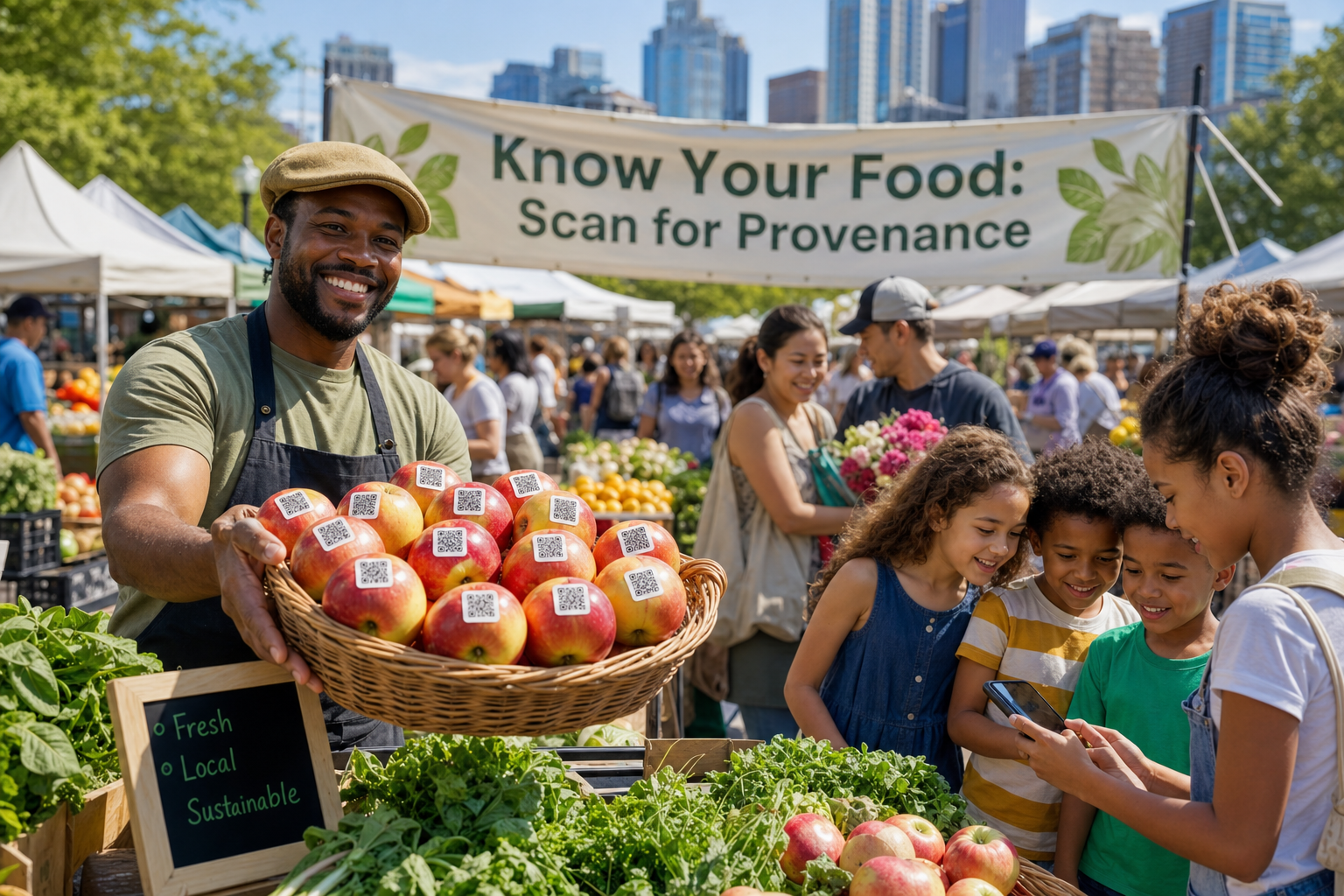
That is the deceptively boring idea underneath a genuinely radical shift. The humble QR code — or more precisely, the open GS1 Digital Link standard behind a growing number of them — is quietly turning packaging into a doorway. Point a basic phone camera at it, and instead of a static advertising page, you land on a live record: harvest date, farm coordinates, chemical and pesticide history, carbon footprint, recall status. No intermediary interprets it for you. You read the provenance yourself, at the shelf, in the three seconds before you decide.
The plumbing to make this normal is already being laid. GS1's Sunrise 2027 initiative aims to move retail checkout worldwide from the fifty-year-old linear barcode to 2D codes capable of carrying exactly this kind of rich, dynamic data — and the industry is leaning in, with surveys showing the overwhelming majority of brand owners and retailers backing the transition. On the data side, event standards like EPCIS 2.0 give supply chains a common grammar for recording who did what, where, and when. The scaffolding of a citizen-readable food system is going up around us, mostly unnoticed.
And consumers, it turns out, want the window. In the UK, well over half of shoppers say they would find point-of-origin and sustainability information genuinely useful on a scan; roughly four in five have already scanned a product code at least once. Across Europe, a majority express concern about how their food is produced, and — the part that matters to anyone building a business here — meta-analyses consistently show people will pay a premium for verified short-supply-chain and organic provenance. The willingness is not hypothetical. It is measured.
But — and this is the caveat that separates the serious projects from the theatre — a scan is only as honest as the data behind it. Here lies the oldest problem in computing, dressed in farmer's overalls: garbage in, garbage out. A tamper-proof ledger proves nobody edited a record after it was entered. It says nothing about whether the record was true the moment it was created. An immutable lie is still a lie. This is the single hardest problem in democratized provenance, and the honest players know it. The interesting work now is less about making data unchangeable — that is largely solved — and more about anchoring the original claim to something real: an identified human who attests, on site, that this harvest happened here on this date; signatures; anti-clone tags; sensor data from the field. Trust has to be manufactured at the source, or it is not trust at all. It is decoration.
A necessary distinction: enterprise traceability is a different animal
Here a caveat is worth planting firmly, because these two ideas get muddled constantly. When people hear "food traceability," they reach for the famous corporate examples — IBM Food Trust, Walmart, Carrefour — and conclude the problem is already solved. It is not. Those platforms solve a genuinely important problem, but it is a different problem, for different people, and conflating the two is how good analysis goes wrong.
What did those giants actually build, and why? Walmart's headline pilot with IBM, run on Hyperledger Fabric, cut the time to trace a batch of mangoes back to its farm from nearly seven days to 2.2 seconds. Read that again: the goal was recall speed. When an E. coli outbreak hits, the gap between a week and two seconds is the gap between dumping an entire product category and pulling only the affected farm's crop — lives and livelihoods saved. Carrefour built blockchain-backed product lines for much the same reason. This is traceability as corporate risk management: faster recalls, cleaner audit trails, reduced liability, smoother B2B logistics among the retail giants that already share GS1 and EPCIS standards. It is real, and it is valuable. It is also not what we have been talking about.
Notice who it is for. The beneficiary is the retailer, the supply-chain operator, the regulator — not the citizen at the shelf. The data sits in permissioned, consortium-controlled ledgers, not open ones. The pricing is enterprise SaaS built for Fortune-500 balance sheets, which is precisely why it prices out the smallholder, the urban grower, the artisanal producer. And the tell is in the results: even Walmart, with the muscle to mandate its leafy-greens suppliers onto blockchain, watched adoption stall — onboarding proved prohibitively expensive, smaller suppliers struggled, and in the four years after launch barely another product line was added. When a QR code from one of these systems reaches a shopper at all, it usually opens a polished marketing page, not a raw, verifiable provenance record you can interrogate yourself.
So the enterprise platforms and the democratized, citizen-facing proof of origin this essay is about are not rivals on the same field — they are playing different sports. One asks, how fast can we find the source when something goes wrong? The other asks, can anyone — a shopper, a small farmer, a city hall — verify the truth of a claim, for free, without permission? Both wrestle with the same GIGO problem. But only one of them leaves a vast territory unserved: the independent producer, the anti-fraud citizen utility, the legible local food shed. That territory is the subject of everything else here. Don't mistake the walled garden for the open field — and don't let anyone tell you the garden is the whole landscape.
Regulation: the forcing function that keeps moving
For years, transparency in food was a virtue you could opt into. That era is ending, and regulation is the reason. Around the world, lawmakers have shifted from encouraging voluntary disclosure to mandating digital traceability — and this is the tailwind that did not exist when the first generation of provenance startups launched into indifference.
In the European Union, the Digital Product Passport, arriving under the Ecodesign for Sustainable Products Regulation, will give products a digital identity carrying lifecycle and origin data, accessible from a standard scan; the working plan runs through 2030, with food-sector expectations still taking shape. The Corporate Sustainability Reporting Directive drags Scope 3 emissions — the sprawling, hard-to-see footprint of the supply chain — into mandatory accounting. Across the Atlantic, the United States' FSMA Rule 204 requires detailed electronic records of "critical tracking events" for high-risk foods. Australia is building national agricultural traceability credentials for its high-value exports; China has stood up state-backed traceability focused on food safety and cold chain. The direction of travel is unmistakable and global.
And yet — here is where an honest state-of-the-field assessment has to resist its own hype — the timelines keep slipping. The EU's Deforestation Regulation, which will demand GPS-precise plot coordinates proving that coffee, cocoa, soy, and palm are deforestation-free, was pushed back yet again: large operators now face December 2026, smaller ones mid-2027, with the rules simplified along the way so that the smallest producers can file a one-time declaration and even use a postal address instead of geolocation. In the US, FSMA 204's compliance deadline was extended by thirty months to July 2028. The regulatory wave is real, but it breaks slowly, and every delay is a lobbying victory dressed as administrative pragmatism.
What should we read into that? Not that the mandates are hollow — they are coming — but that anyone betting a business or a policy purely on a compliance deadline is standing on sand. The durable demand is not "because the law says so on this date." It is the deeper, non-negotiable pull underneath: fraud that keeps rising, and consumers who keep asking harder questions. Regulation accelerates the shift. It does not create it, and it cannot be trusted to arrive on time.
The other half of the story: cities that want to know where dinner comes from
Now turn the telescope around. Everything above is about proving where a single product came from. But the same information, aggregated, answers a much bigger question that cities have started asking out loud: where does our food actually come from, and how fragile is that?
The past few years taught a hard lesson. Long, lean, globe-spanning supply chains are miracles of efficiency right up until the moment a canal blocks, a war starts, or a harvest fails — and then they are revealed as brittle. Empty shelves have a way of concentrating the political mind. Cities responded not with slogans but with policy, and the scale of it is easy to miss. The Milan Urban Food Policy Pact, ten years old in 2025, now links more than 330 cities across six continents, from Copenhagen to Nantes to Berlin to Turin, all treating food not as something that simply arrives but as a system to be governed, mapped, and made resilient.
Democratized proof of origin is the sensory organ for this ambition. When provenance becomes legible at the level of the individual apple, it becomes legible at the level of the neighborhood, the district, the city. You can finally see the food shed — which farms actually feed which streets, how short or long the chain really is, what a genuinely zero-mile purchase looks like. Visibility of that kind does something subtle and powerful: it turns "buy local" from a vague virtue into a verifiable fact, and it turns local economic circularity into something a city can measure and defend.
Two nuances keep this from tipping into romance. First, the science. The original "food miles" idea — that closer is always greener — did not survive contact with life-cycle assessment. Transport typically accounts for only 5 to 10 percent of a food's carbon footprint; how it was produced dominates the rest. A tomato trucked from a nearby heated greenhouse can easily out-emit one shipped from a sunny field far away. Distance is a seductive proxy, but the honest metric is resource intensity — energy, water, inputs, waste — not kilometers alone. Second, the cautionary tale. The most futuristic answer to urban food, high-tech vertical farming, took a brutal correction: something like fourteen vertical-farm operators went bankrupt in 2025, following earlier high-profile collapses, as energy costs and unit economics caught up with the hype. The survivors are leaner and real, but "grow it all in a downtown tower" is no longer the headline. Resilience, it turns out, is less about one dazzling technology and more about a diverse, visible, verifiable web of local and regional producers. Which brings us back to provenance — the connective tissue that makes such a web trustworthy.
Around the world, the phone leapfrogs the lab
It would be a mistake to read this as a rich-world story of premium apples and boutique QR codes. Some of the most consequential work is happening in the Global South, where the constraint that shaped everything else — expensive, centralized verification — was never affordable in the first place.
Where smallholder farmers grow much of the world's coffee and cocoa, mobile-first traceability is doing something the enterprise systems never managed: reaching the actual farmer. Projects across Africa and Latin America — coffee and cocoa growers in Honduras, cocoa cooperatives in Peru, and a growing field of blockchain-plus-mobile ventures documented by the mobile-industry's own development arm — are testing whether a farmer with a basic phone can attest to origin directly, capture a premium that historically evaporated somewhere up the chain, and satisfy the deforestation and traceability demands that European buyers now impose. The lessons are sobering as often as they are inspiring: connectivity gaps, literacy barriers, and the GIGO problem all bite hardest here. But the leapfrog logic is compelling. A region that skipped landlines for mobile can skip the corporate audit for the witnessed digital record. When verification gets cheap enough to put in every pocket, the places that could never afford the old model have the most to gain.
This is also where the movement's grassroots DNA shows. Long before "digital product passport" entered anyone's vocabulary, farmers were building trust peer-to-peer: Participatory Guarantee Systems, in which local growers and citizens certify each other and cut out expensive third-party auditors; community-supported agriculture and Solawi models that replace the anonymous chain with a direct human relationship; open-source platforms like the Open Food Network that let independent producers run shops and regional hubs outside supermarket gravity. Democratized provenance is, in one light, simply these old trust networks given a digital spine — the witness made portable, the handshake made verifiable at a distance.
The unglamorous question: who pays?
No serious look at the outlook can dodge the economics, and here the field has to be clear-eyed. The consumer, for all their expressed willingness, will not download an app or pay a subscription to interrogate an apple. That experience must be free and frictionless — a plain scan, no gatekeeping — or it simply will not happen at scale. Which means the value has to be captured somewhere else along the chain: from producers who use verified provenance as a differentiator and an anti-fraud moat; from certifiers and community schemes seeking a cheaper alternative to costly audits; from local retailers and food hubs selling trust as a feature; and from any operator who, thanks to those slow-but-certain mandates, will soon have to keep these records anyway.
The demand side of this market is, by any honest reading, healthier than it has ever been. Analysts put the food traceability market around $36.9 billion in 2026, on a path toward roughly $67 billion by 2034, with the software-and-solutions layer growing faster still. The pull is regulation, fraud, and consumer transparency, all pulling at once. The unsolved puzzle is not whether people want this. It is who reliably pays for it — and the winners of the coming decade will be decided less by the elegance of their cryptography than by the discipline of their business model.
The outlook: trust, redistributed
Step back, and the shape of the thing becomes clear. We are living through a redistribution of a scarce resource, and the resource is trust. For a century it was concentrated — in laboratories, in corporate consortia, in regulators, in the walled gardens of enterprise supply-chain platforms built for Fortune-500 retailers and priced accordingly. The technologies now maturing — open standards, cheap scans, witnessed capture, mobile-first tools — are pushing that trust outward and downward, toward the farmer who grows the food and the citizen who eats it.
It will not arrive tidily. The mandates will keep slipping. The GIGO problem will keep humbling anyone who mistakes immutability for honesty. Vertical farms and other silver bullets will keep disappointing. And the money question will keep separating the durable projects from the demos. But the direction is set, because the two forces underneath it — rising fraud and rising demand for the truth — are not going away. If anything, they are compounding.
So the next time you stand at the shelf and ask that apple where it comes from, notice that the question is starting, finally, to have an answer you can check yourself. That small shift — from taking it on faith to seeing it for yourself — is what democratized proof of origin actually means. And it may turn out to be one of the quieter, more consequential redistributions of power in the food system in a generation.
Where does your food come from? For the first time, that is becoming your question to answer — not someone else's to keep.
Sources and further reading: Global food fraud surge, 2025 (FoodNavigator) · Food fraud 2026 targets and tactics (New Food Magazine) · Food Traceability Market size & forecast (Fortune Business Insights) · Food Traceability Solutions Market, ~10.7% CAGR (Global Growth Insights) · EU Deforestation Regulation timeline and delay to Dec 2026 (Coolset) · EUDR targeted revision adopted (European Parliament) · FSMA 204 compliance date extended to July 2028 (Food Safety Magazine) · EU Digital Product Passport under ESPR (Circularise) · GS1 Sunrise 2027 & consumer QR demand (GS1 UK) · What is GS1 Sunrise 2027 (GS1 US) · Consumer WTP for short food supply chains, meta-analysis (PMC) · Ten years of the Milan Urban Food Policy Pact (Eurocities) · Blockchain in agriculture: global lessons for smallholders (GSMA) · Walmart/IBM Food Trust on Hyperledger Fabric: mangoes traced 7 days → 2.2 seconds (LF Decentralized Trust case study) · Walmart puts pricey blockchain food-tracking platform on ice — adoption stalled on cost (PYMNTS) · Walmart mandates blockchain for leafy-greens suppliers (Grocery Dive) · Why vertical farms go bankrupt (Foodlore)