.svg "protagx-logo (1024 × 300 px)")

The Champion Who Forgot His Own Style
Data Divers Dialogs · Critique · ~8 min read
HubSpot taught an industry that you don't have to chase customers to win them. Now, in the middle of its worst stretch since going public, the company is cutting its partners' commissions and charging them for the privilege of staying. A view from someone who is one of those partners — and who is less interested in the anger than in what the timing gives away.
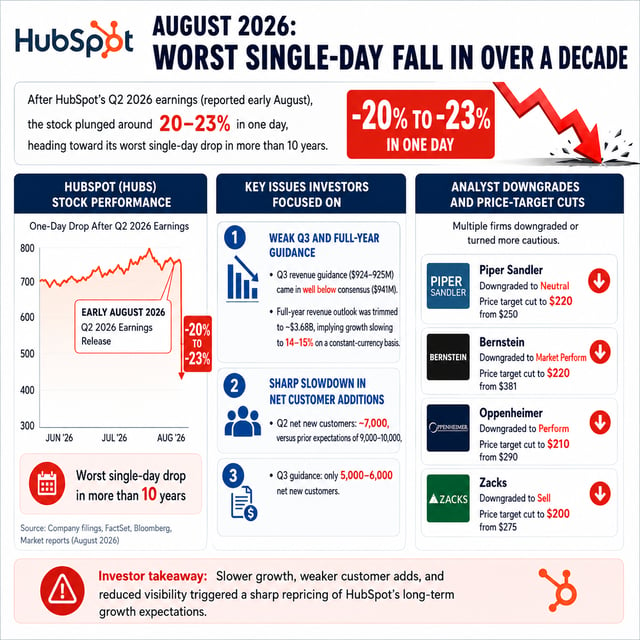 On 5 August 2026, HubSpot reported a quarter that, by the market's own rules, was a good one. Revenue of $911.7 million, up nearly 20 percent, above expectations. Earnings per share of $3.26, also above. A double beat.
The next day the stock fell by as much as 23 percent, to around $197 — the largest single-day drop in the twelve years the company has been public.
The market had looked at a single line. HubSpot had added 7,000 new customers where 9,000 to 10,000 were expected. For the coming quarter it guided to just 14 percent growth.
CEO Yamini Rangan put it plainly on the earnings call: April got off to a slow start, and the quarter they had expected did not fully materialise.
A company earning more than ever is punished because the new customers aren't coming. It's worth letting that sentence sit, because it explains everything that follows.
I'll still start fairly, or the criticism comes cheap. Because what HubSpot once was, was genuinely remarkable.
The Style That Struck No One
The style was called Inbound, and the idea was almost impudently simple: stop chasing people. Write something so good they come to you. No cold-call brawling, no interruption marketing. Be useful, and be willing to wait.
In 2006 that was heresy. It worked. HubSpot built an entire ecosystem on it: an academy that trained people for free, a CRM that stayed free permanently, and a partner programme that paid agencies twenty percent. For the customer's lifetime.
That was not a discount scheme. It was an invitation to grow old together. Thousands of us built our businesses on it — consultancies, agencies, one-person shops like mine. We didn't just sell software. We stood for a stance.
And none of that has become false in hindsight. The free CRM is still there. On G2, Marketing Hub sits at 4.4 out of 5 across more than 13,000 reviews; on Capterra, 4.5. This is not a product people hate. It's a product people like and whose invoice they dread.
That's exactly the problem. Criticising a bad product is boring. Watching a good one forget its own idea is not.
When the Ground Gave Way
Why does a market leader change its style? Rarely from arrogance. Usually from fear.
In November 2024, HubSpot had around 13.5 million organic website visitors a month. By December it was 8.6 million. Across the first half of 2025, independent analyses put the drop at 70 to 80 percent. Google now answers questions itself — AI Overviews, zero-click search — and nobody clicks through any more.
The inventor of inbound marketing can no longer be found.
Management admitted as much, dryly, the way you read out a diagnosis: the AI delivers the answers, fewer people click through to websites. The company's own numbers behind it are harder still. In 2022, 61 percent of leads came from educational content. In 2025, 28.
That isn't a marketing problem. It's an engine failure at full speed.
The market had understood this well before August. The all-time closing high of November 2021 was $852; by spring 2026 the stock hovered around $215. As early as 8 May 2026 it had fallen roughly 19 percent in a day, after HubSpot announced its shift to outcome-based pricing and conceded that many of its salespeople had spent April in AI training rather than selling. August was the second slap of the same year.
And in the summer of 2024, Google had already looked the company over, negotiated an acquisition — and walked away before it even reached due diligence.
| All-time closing high (16 Nov 2021) | $852 |
| Price after Q2 results (6 Aug 2026) | ~$197 |
| Single-day loss, 6 Aug 2026 | up to −23% |
| Net new customers Q2 2026 (expected: 9–10k) | ~7,000 |
| Growth guidance Q3 2026 | ~14% |
Sources: HubSpot Q2 2026 earnings (5 Aug 2026) and earnings call; Seeking Alpha, Benzinga, Investing.com; Macrotrends; Bloomberg (acquisition talks ended July 2024 without due diligence).
It Isn't Only HubSpot
One sentence for fairness, or the piece turns dishonest. What HubSpot is living through in 2026, half the industry is living through. The market has given it a half-mocking name — the SaaSpocalypse — and the fear behind it is radical: if AI agents do the work you used to put people and licences on, why keep paying per seat? By spring 2026, that single question had erased roughly two trillion dollars in software market value. Salesforce, ServiceNow, Atlassian, Figma — all down, some as deep as HubSpot.
No pricing model on earth would have prevented that fear. It isn't aimed at a company. It's aimed at an idea: that you sell software by the head.
But this is exactly where the distinction this piece is about becomes worth drawing. The crash happened to HubSpot — as it did to everyone else. It's weather. What HubSpot does with its partners is not weather. It's a decision. And decisions can be judged.
What the Invoice Actually Says
Let's start with the question everyone asks: what does it cost to send a marketing email?
Free, HubSpot says — 2,000 sends a month, with HubSpot branding on every one. Starter, $20 per seat, removes the branding and allows ten automated actions. No workflow builder. Anyone who wants real automation — branching, A/B tests, segmentation — lands on Professional: $800 a month, plus $3,000 in mandatory onboarding.
From 20 to 800. For a feature that has existed for fifteen years.
For a European buyer there's a second layer the US price sheet doesn't show. List prices are in dollars, but you're invoiced in euros at a rate HubSpot sets, and mandatory onboarding is quoted before local VAT. The headline number is the floor, not the ceiling.
Over three years, depending on configuration, it adds up like this:
| Configuration | 3-year TCO |
|---|---|
| B2B SaaS (Enterprise, 60k contacts, 47 seats) | $386,160 |
| Financial Services (Enterprise, 40k contacts, 38 seats) | $334,320 |
| E-Commerce (Enterprise, 150k contacts, 26 seats) | $323,160 |
| Healthcare / Life Sciences (Enterprise, 25k contacts, 24 seats) | $259,800 |
| Manufacturing (Professional, 20k contacts, 21 seats) | $124,320 |
| Agency (Professional, 12k contacts, 16 seats) | $91,020 |
Own model based on public list prices (as of August 2026), annual billing, before discounts and before VAT. HubSpot does not price by industry; the differences come purely from industry-typical configurations. Assumptions: Marketing Hub as anchor, Sales Pro $100 / Ent $150 per seat, Service Pro $90 / Ent $150, additional marketing seats $45, contact overage Pro $250/5,000 and Ent $100/10,000. Estimates, not quotes.
And now the number that surprised me when I ran it.
Half the industry is arguing about the AI credits. About Breeze, about the cheek of selling "intelligence" that's a single prompt away elsewhere. I've thought out loud about it myself.
Across all seven configurations, credits come to under three percent of the monthly bill. Seats come to between 19 and 53.
We're hammering the line item that costs the least. That isn't carelessness, it's convenience — on both sides. As long as we're outraged about credits, nobody talks about 5 March 2024. That was the day unlimited users vanished from Marketing Hub; whoever used to put ten people in an account now paid per seat. No blog post celebrated it, no keynote. It was in a changelog. That was the real blow. The credit debate is the footwork that hides it.
What still grates about the credits isn't the price but the mechanics. They expire monthly, no rollover. Exceed your allowance and you're automatically moved up a tier — for the rest of the term. You only come back down at renewal. A ratchet that clicks in one direction only.
Whoever Holds On Has Stopped Dancing
HubSpot's contract terms are public, in its own knowledge base; I'm not quoting forums. Contracts renew automatically unless you object beforehand. Cancellation mid-term is not permitted. There are no refunds for paid periods. Downgrades mid-term, likewise, are not possible.
Whoever realises in month eight of twelve that they've mis-bought pays to the end. Combined with onboarding — $3,000 on Marketing Pro, $7,000 on Enterprise, $3,500 each on Sales and Service Enterprise, all due in year one — that makes for a non-recoverable first-year commitment of somewhere between roughly $32,000 and $136,000.
For me, as a consultant working in regulated industries, this is not a pricing question but an architecture one. Anyone building GxP environments settles exit costs, data portability and the auditability of consumption-based billing before anything is signed. And here the European angle is not decoration. A contract that renews itself unless actively stopped sits awkwardly beside the consumer-contract reflexes of EU law; the "sole discretion, final" clause on partner commissions would not survive the same wording in many European B2B relationships without challenge. A credit ratchet that upgrades itself, and whose consumption the customer cannot cap, is not a pricing detail in a validated context. It's a risk on the requirements list.
What Happens to the Partners
Here I stop pretending to be neutral — not because I take it personally, but because this is where I can see most clearly. I am one of the partners.
And from that position, one thing stands out above all: the timing.
Everything so far — the crash, the prices, the credits — is context. It explains why HubSpot is under pressure. But being under pressure is not a fault; it's a situation. What becomes interesting is what a company does in that situation. And HubSpot is doing, right now, exactly what a company does when it no longer needs its sales partners.
Remember the 7,000 customers missing in August? The slow quarterly start the CEO herself admitted? That is the moment an ecosystem needs its evangelists most — the people who carry the product into rooms the direct sales force never enters. And it is precisely this moment HubSpot chooses to introduce a partner membership fee, cut commissions, and shut down an entire partner programme.
You don't have to find that outrageous to find it remarkable. A company sure of its position does not tax its sales channel in the middle of a crisis. That HubSpot does it anyway allows exactly two readings. Either it expects not to need the partners in future, because direct sales and AI are meant to fill the gap. Or it needs the partners' cash in the short term more than their loyalty in the long term. Both readings should unsettle anyone who has built a business on this platform.
The chronology is in HubSpot's own documents:
| Date | Change | |
|---|---|---|
| 2010 | 20% commission, lifetime | The promise |
| 1 April 2023 | new deals capped at 36 months | First cut |
| 1 April 2025 | legacy deals only with active "management"; proof window cut 90 → 60 days | Second |
| 17 Nov 2025 | deal-based model; partner feedback becomes HubSpot property, uncompensated | Third |
| 15 July 2026 | mandatory $400/month partner fee | Fourth |
| 15 Aug 2026 | Solutions Provider Program discontinued, commissions end immediately | Fifth |
| January 2027 | minimum performance: > 0 sourced points | Sixth |
Sources: HubSpot "2023 Solutions Partner Legacy Commission Plan"; "Understanding Your Partner Commissions"; "2026 Entry and Tiers Policy for HubSpot Solutions Partners."
Six tightenings in three years, each too small on its own for a headline. "We'll grow old together" became a $400-a-month membership fee for the right to keep selling.
For many partners this is a personal story — livelihoods built on a promise now unilaterally rescinded. I understand the anger, and it's justified. But it isn't my point. My point is cooler, and more uncomfortable for HubSpot: it is not a good sign for a platform's health when the people who know it best begin hedging their business against it.
Two details from the chronology stay with me.
The first is a sentence. On the question of when a partner is "actively managing" a customer and thereby keeps their legacy commission, HubSpot writes that the assessment lies at the company's sole discretion, and the decision is final. Not reviewable, not negotiable. You read it twice to grasp what it does to a business model that rests on it.
The second is in the November 2025 contract update: partner feedback on products, prices and programmes passes into HubSpot's ownership, without payment, without attribution. We may go on explaining how the product gets better. We may simply no longer expect to own what we say.
One might object that HubSpot is not alone in this — other platforms are thinning their partner programmes too. True, and it's a subject of its own. But it changes nothing here. That others take the same road does not make it more of a partnership.
A partner is someone you share risk with. Whoever passes on the risk and keeps the return has no partners. They have a sales channel they don't have to pay — and one they bill when things get tight.
And What About Us?
Now the part I'd rather leave out.
A consultant's blog trying to guide agencies through the new rules gives a piece of advice that sounds like an aside and is a confession: raise your own prices now, and rebuild your financial models so they're profitable without HubSpot's commissions.
The sentence means: a meaningful part of this industry was not profitable without them. We recommended software we earned twenty percent on, and called that recommendation consulting.
I don't exempt myself. I spent years defending an ecosystem that paid me. The question isn't how HubSpot can do this to us. It's why my recommendation was tied to a commission in the first place — and what it was worth if it was.
Whoever hangs their judgement on a commission hasn't sold judgement, but placement. And whoever, when the commission disappears, suddenly asks whether they can still represent the product in good conscience is also answering what that conscience was worth before.
That's the most uncomfortable paragraph in this piece, and it's aimed at me as much as anyone.
And while we're on uncomfortable truths: analysts trace the trigger of the whole selloff partly to agentic AI tools — tools that take on tasks you used to need software subscriptions for. I'm writing this piece with one such tool. So you don't criticise HubSpot's prices from a neutral corner, but from precisely the future that's dragging HubSpot's stock down. That excuses nothing above. But it should keep the tone humble.
The Scorecard
Is HubSpot finished? No — and anyone who says so is selling a different CRM.
The company is earning as never before: in the second quarter of 2026, earnings per share of $3.26, 306,000 customers, free cash flow of $168 million, a buyback programme topped up by a billion. The product is good, the free CRM still one of the most generous on the market. And HubSpot made amends in 2025: standard enrichment became free, the credit model cheaper, there are 28-day trials.
But the combination is the point, and the market named it on 5 August. Growth slows, profitability rises, new customers stay away, and existing ones get monetised more densely: seats, expiring credits, add-ons, partner fees, tighter lock-in. Analysts have a word for it — harvest mode. You no longer grow outward, you take more from what's already there.
And I want to stay fair: part of this pressure is not HubSpot's fault. The fear of AI hits the whole industry, and it hits a company with mid-market customers and a growth valuation harder than the sluggish giants — those budgets are cut first, and switch fastest to a cheaper AI agent. You cannot fault a company for the ground going soft under an entire business model.
What you can fault it for is the choreography. Not the prices — a company may charge what the market bears. But the way they're hidden: the onboarding fee that only appears in the calculation once you've signed. The credits that expire and upgrade themselves. A company under pressure is allowed to raise prices. It just needs the nerve to say so.
And then there's the handling of the partners, which weighs heaviest for me — not because it hurts most, but because it gives away most. A crash is weather; it hits the whole industry. A commission cut in six stages is a decision, and it falls in precisely the quarter direct sales stalls. A company that taxes its sales channel while its own customer numbers collapse says more about its position than any investor slide.
That is not a crime, but a phase. Every market leader reaches it. What distinguishes one in that phase isn't whether it grips harder — but whether it admits it.
The company that taught the world you don't have to strike to win is holding on today, and calling it dancing.
Practically, for anyone building on HubSpot, this means two things. Calculate your TCO over three years and with seats as the main line item, not the platform fee. And if you're a partner tied to this ecosystem: build your business so it stands without the commissions. Not out of resentment — but because the chronology above says fairly clearly where this is going. That the partners are doing exactly that, incidentally, is the most honest market signal on HubSpot there currently is. The people who know the product best are hedging. That should leave no one cold — HubSpot least of all.
The rest was already said once. Be useful. Be willing to wait. Win without striking.
The champion hasn't forgotten it. He has decided to stop — starting with the ones who watch most closely.
On the figures: All price, contract and programme details come from publicly accessible HubSpot sources (pricing pages, knowledge base, Solutions Partner Program policies) as well as SEC filings and earnings calls, as of August 2026. The TCO figures are own model calculations based on list prices before discounts and before VAT, and are estimates, not quotes. HubSpot does not price by industry; differences follow from industry-typical configuration assumptions. The price of the transactional email add-on ($600/month) comes from third-party sources and is not stated on HubSpot's public pricing page. Assessments and conclusions are the author's opinions on the basis of the stated facts. Prices and programme terms change; the vendor's current documentation is always authoritative.