
Data Divers Dialogs · Analysis
Since 1 October, new HubSpot customers in Europe pay for every marketing email they send. For the small team that used to buy Customer Platform Starter, that changes what is expensive. It also changes what is suddenly cheap.
By Christian Schappeit · Data Divers Dialogs · November 2026 · approx. 7 min read
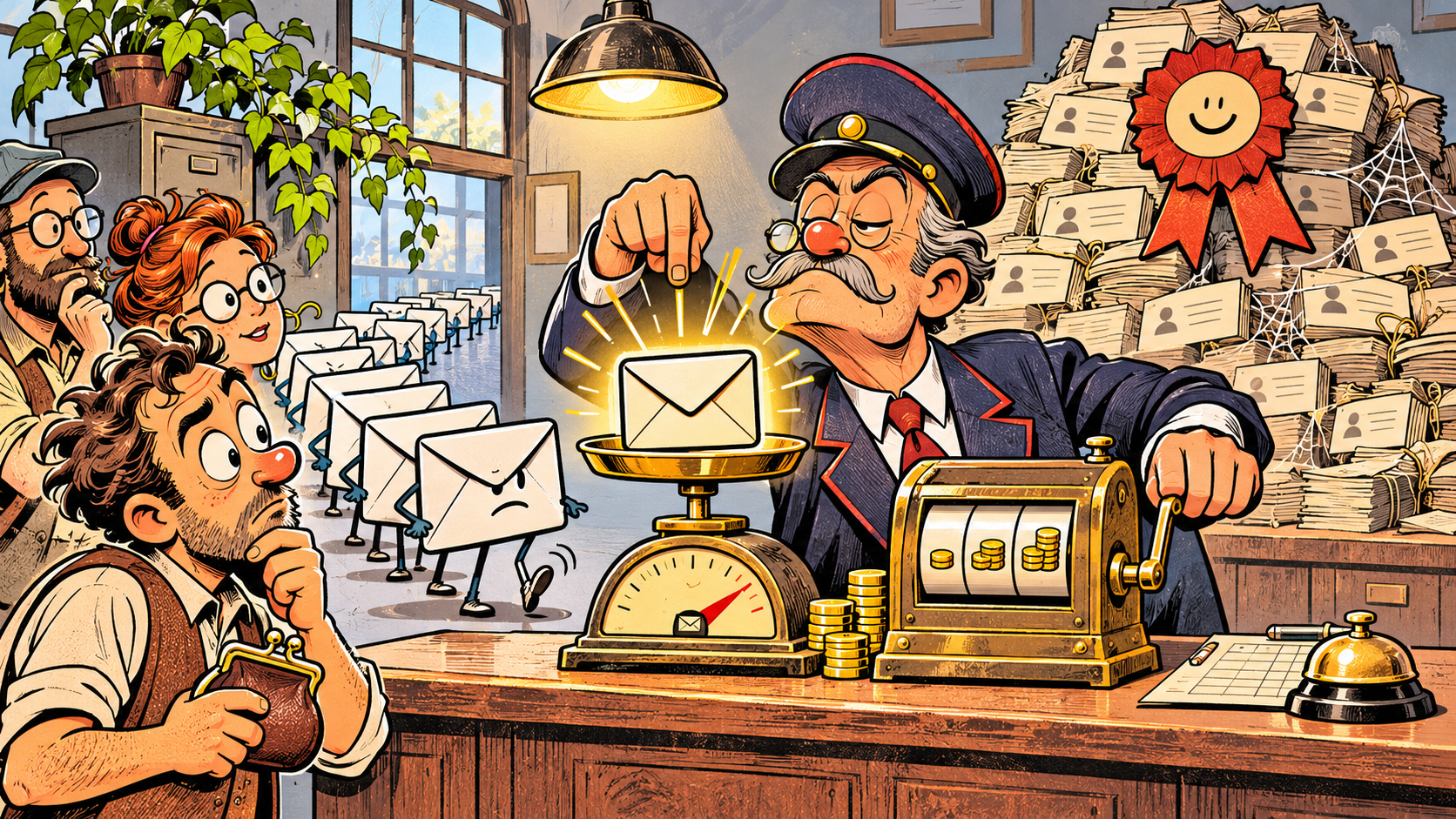
On 1 May 1840, Britain began selling a small black stamp with the young Queen Victoria on it. The Penny Black did something quietly radical. It made the sender pay, a fixed price, per letter. Until then the recipient usually paid on delivery, and plenty of recipients simply refused the letter.
For about thirty years, email looked like the end of that story. Writing to one person cost the same as writing to ten thousand: nothing you could see.
On 1 October 2026, HubSpot brought the stamp back. Not for everyone, and not under that name. But a new customer in Europe who sends a marketing email through HubSpot now pays 15 credits for it. A credit costs one euro cent.
STARTER, NEW
The seat costs the same. Almost nothing else does.
Picture the customer HubSpot used to pitch Customer Platform Starter to. Everything you need to scale your business, bundled together and discounted. A small firm, three people, a CRM, a newsletter, a few forms on the website. For them the bundle was the obvious buy: every Starter hub, one price per seat.
A firm like that, signing up today in Europe, can no longer buy it. It gets the Starter edition of the new model instead. The seat looks familiar: €20 per GTM seat per month on the list, with HubSpot advertising €7 on annual billing as a promotion. At most ten paid seats. No Ops seat at all.
The difference is in what comes with the seat.
The old Starter bundle included 1,000 marketing contacts, email sends up to five times your contact tier each month, 500 HubSpot credits for AI features and 500 calling minutes for the account.
The new Starter edition includes 25,000 records across every object, with marketing contacts counted inside that number and no longer billed separately. It includes 5,000 credits a month and 100 calling minutes per seat, pooled. And every bulk or automated email now draws on those credits.
Ten times as many credits. Then the bill for the newsletter.
THE ALLOWANCE
What 5,000 credits actually buy
5,000 credits sounds generous until you divide. At 15 credits per email for the first 10,000 sends a month, the allowance covers about 333 marketing emails, if nothing else touches it. A workflow action costs 3 credits. A call minute beyond the included ones costs 10. Credits reset on the first day of the period. Unused ones vanish.
For Starter there is exactly one pack built for the job, the Base Marketing Pack: €150 a month for 2,500 sends, 250 workflow actions and 2,500 credits. The cheaper send packs are reserved for Professional and Enterprise. Extra records cost €5 per 1,000.
One sentence in HubSpot's knowledge base deserves a second reading. You can set a maximum monthly credit limit, which is sensible. When the account reaches it, features that use credits pause until the next reset date. The welcome email for the person who just filled in your form then waits, politely, for the first of the month.
WORKED THROUGH
Three firms, one price list
These are models, not customers. List prices, per month, before VAT, no promotions. Three seats unless stated.
The newsletter firm. 2,000 marketing contacts, two newsletters a month, 4,000 sends.
Old Starter: €60 for seats, about €46 for the second thousand marketing contacts. The sends sit comfortably under the cap of 10,000. Around €106.
New Starter, pay as you go: €60 for seats. 4,000 emails at 15 credits are 60,000 credits; minus the 5,000 included, 55,000 remain at one cent. €610.
New Starter with the Base Marketing Pack: €60 plus €150. The pack covers 2,500 sends. The other 1,500 cost 22,500 credits, of which 7,500 are already paid for. The last 15,000 cost €150. €360.
More than three times as much, for the same two newsletters.
The address collector. 10,000 marketing contacts gathered at trade fairs and through downloads. The firm actually writes to the 1,000 who still open anything, once a month.
Old Starter: €60 plus nine extra thousands at about €46 each. Around €474. You paid for every address marked as marketing, whether you wrote to it or not.
New Starter: €60 plus 15,000 credits, minus the 5,000 included. €160.
A third of the old price. A disciplined admin could have unmarked the dormant contacts under the old model too. Most portals do not have a disciplined admin.
The sales team without a newsletter. Five people, no marketing email, 30,000 records across contacts, companies and deals.
Old Starter: 5 seats at €20. €100.
New Starter: €100 plus 5,000 records over the cap at €5 per 1,000. €125. Calling minutes come out even: 500 either way.
INVENTORY VS. ACTIVITY
The address book got cheap. Talking got expensive.
Put the three side by side and the pattern is hard to miss. The old model charged for inventory: how many addresses you kept as marketing contacts. The new one charges for activity: how often HubSpot speaks on your behalf.
It sounds like an accounting detail. It isn't. The cost moves from the database to the conversation. Owning ten thousand addresses is now nearly free. Writing to them is not.
For a firm that bought Starter because it wanted a decent newsletter and a CRM in the same box, that is the wrong direction. For a firm that collected addresses like airline miles and wrote to a fraction of them, it is a gift.
EXISTING CUSTOMERS
And if you already have Starter?
For now, nothing changes. Existing customers keep their per-hub pricing, and HubSpot has not announced a migration date. When HubSpot last changed models, new customers went first and existing ones followed, renewal by renewal. It is worth knowing your answer before the question arrives.
The meter is already in your portal: your account name, top right, then Account & Billing, Usage & Limits, HubSpot Credits. On today's Starter it mostly shows AI usage. Your email statistics tell you the rest. Take last month's marketing sends, multiply by 15, divide by 100. That is your postage, in euros.
1840
What the Penny Black really changed
Rowland Hill's stamp is remembered for making post cheap. Its quieter effect was moving the cost to the person who decided to write.
HubSpot's rate sheet will not end up in a museum. But the 15 credits may do the same job. Somewhere in a three-person firm, someone will look at the monthly newsletter, the automated "We miss you!" email and the reminder about the reminder, and ask the question free email never forced anyone to ask.
Would we still send this if it cost fifteen cents?
Sources: HubSpot, Flexible seats-and-credits pricing supplement · HubSpot, Customer Platform pricing · HubSpot Knowledge Base, HubSpot Credits and billing · Hacking Demand, seats and credits live in EMEA · Hublead, HubSpot pricing 2026 · Chatarmin, HubSpot prices (marketing contacts on Starter). Worked examples are models at list prices; the old marketing-contact price (about €46 per 1,000 on Starter) is taken from Chatarmin and should be checked against your own contract.